3 min read
In this guide
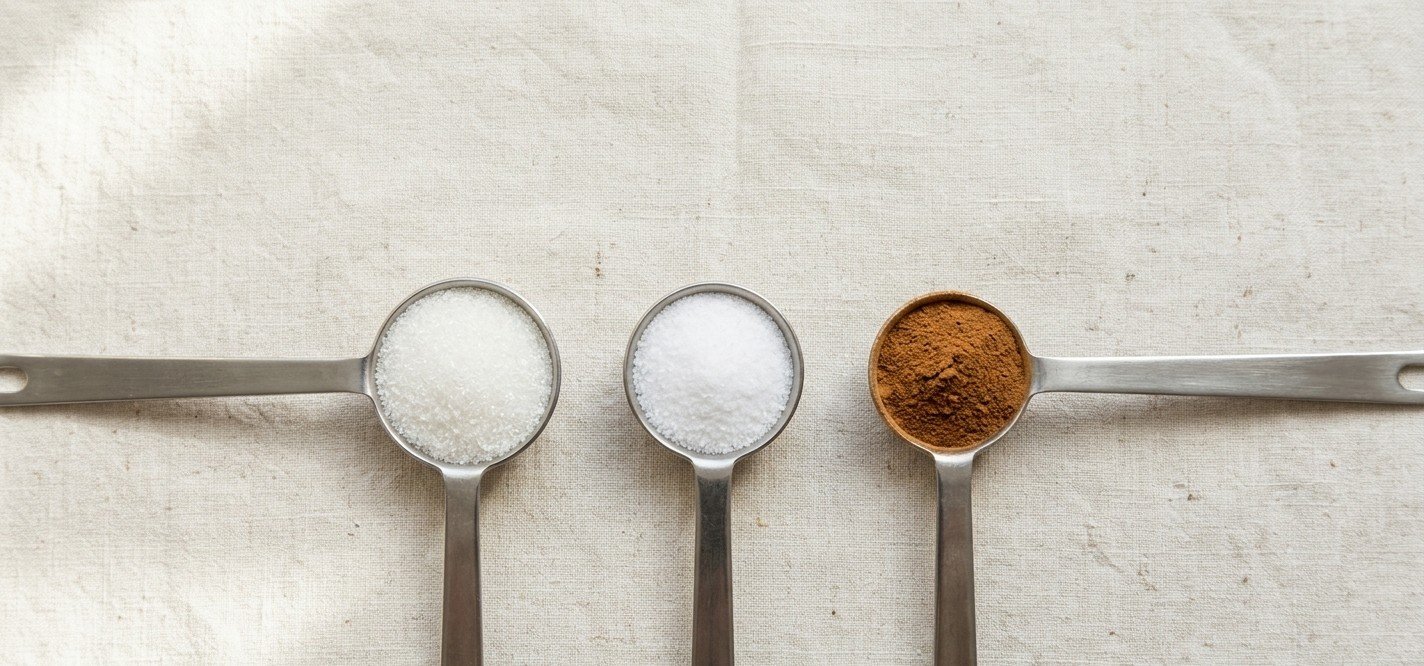
A teaspoon seems like a simple measurement — but how many grams it represents depends entirely on what’s in it. A teaspoon of fine salt weighs about 6 grams. A teaspoon of baking powder weighs about 4 grams. A teaspoon of ground cinnamon is closer to 2.5 grams. Same volume, three different weights.
This guide gives exact teaspoon-to-gram conversions for common baking ingredients, explains why the weights vary, and covers the one international difference worth knowing.
Why Teaspoon Weights Vary Between Ingredients
A teaspoon measures volume, not weight. Dense ingredients like salt and sugar pack tightly and weigh more; fine, airy ingredients like baking powder or ground spices weigh less for the same volume — the same principle that makes a cup of flour weigh differently from a cup of sugar, just at a smaller scale.
Teaspoons to Grams: Reference Table
All values below are based on a standard 5ml teaspoon, level (not heaped).
| Ingredient | 1 tsp | ½ tsp | ¼ tsp |
|---|---|---|---|
| Granulated / Caster Sugar | 4g | 2g | 1g |
| Fine Salt | 6g | 3g | 1.5g |
| Baking Powder | 4g | 2g | 1g |
| Bicarbonate of Soda | 6g | 3g | 1.5g |
| Ground Cinnamon | 2.5g | 1.25g | 0.6g |
| Instant Yeast | 3g | 1.5g | 0.75g |
For ingredients not listed here, use the teaspoons to grams calculator for exact results.
The International Teaspoon Difference
In the US, UK, Canada, and Australia, a standard teaspoon is 5ml — so teaspoon volumes are consistent across all four of KitchenConvert’s main markets. The bigger difference shows up at the tablespoon level: an Australian tablespoon is 20ml, while US and UK tablespoons are 15ml. This doesn’t affect teaspoon measurements directly, but matters if a recipe uses both. See our guide to Australian baking measurements for more.
When Teaspoon Precision Matters Most
For most ingredients — vanilla, spices, sugar — small teaspoon variations have little practical effect. The ingredients where precision genuinely matters are leavening agents: baking powder, bicarbonate of soda, and yeast, which are calibrated carefully against the rest of the recipe. Too much bicarbonate of soda can leave a metallic taste and cause over-browning; too little leaves a cake flat. For a full explanation, see baking powder vs bicarbonate of soda.
Should You Weigh Teaspoon Amounts?
For most home baking, a good set of measuring spoons is accurate enough. Weighing pays off most when scaling a recipe significantly — weighing 12g of baking powder for a triple batch is faster and more accurate than measuring three separate teaspoons. If you do weigh small amounts, make sure your scale measures in 1-gram increments or smaller; many standard scales only register in 2-gram increments, which isn’t precise enough. For everyday teaspoon-sized measuring, a set of accurately calibrated measuring spoons remains the most practical tool.