7 min read
In this guide
- What Is Bicarbonate of Soda (Baking Soda)?
- What Is Baking Powder?
- The Key Difference, in One Line
- Why Some Recipes Use Both
- Can You Substitute One for the Other?
- Why Too Much Leavening Backfires
- How to Test Whether Yours Is Still Active
- Exact Weights: Teaspoons and Tablespoons
- Frequently Asked Questions
- Conclusion
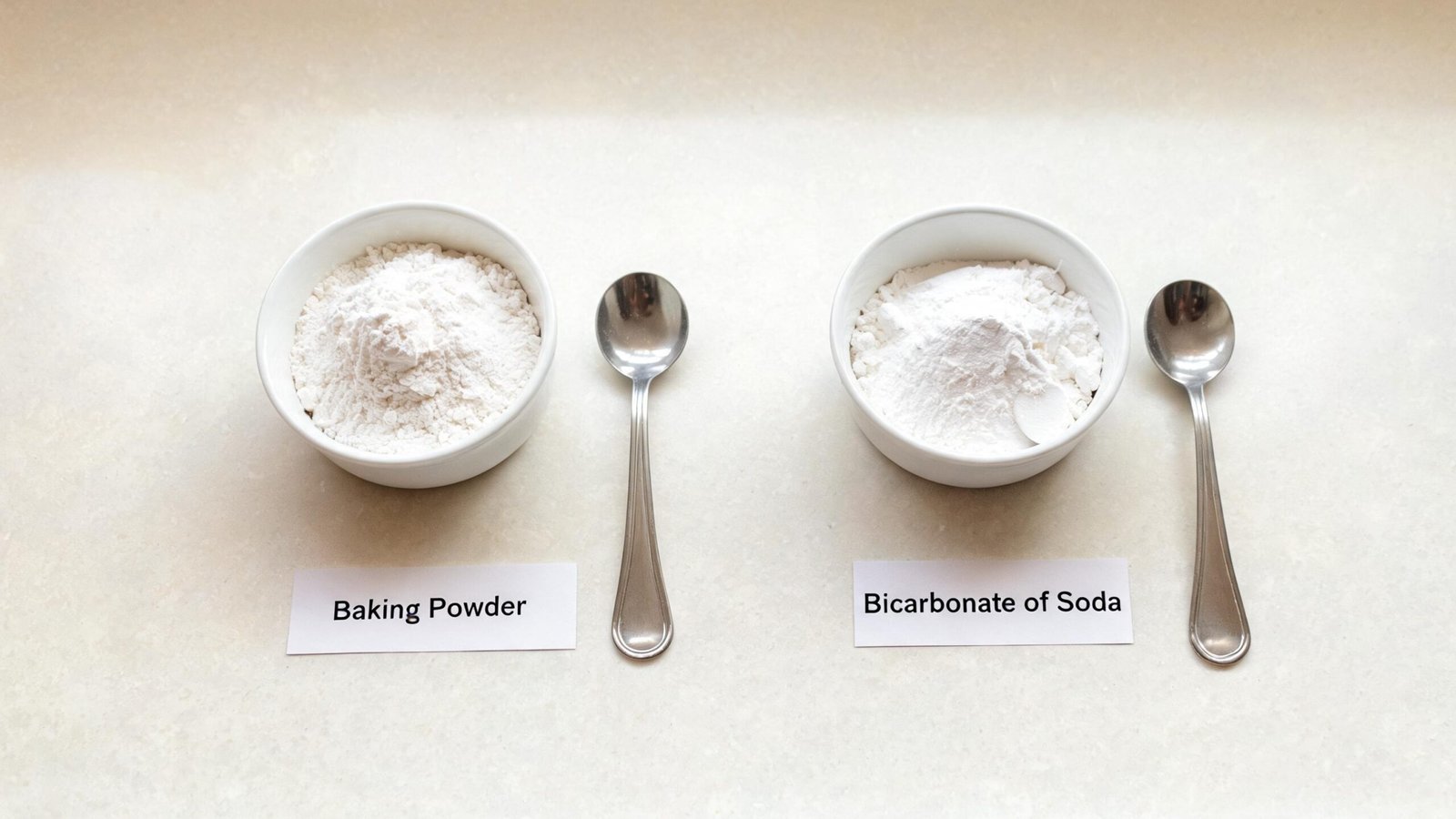
It’s one of the most common mix-ups in home baking: a recipe calls for bicarbonate of soda, but all you have is baking powder — or the other way round. They sit side by side in the cupboard, both look like fine white powders, and both make cakes rise. But they work in completely different ways, and swapping one for the other without adjusting the recipe is one of the most reliable ways to end up with a flat, bitter, or soapy-tasting bake.
Here is exactly how each one works, when to use which, and how to substitute safely if you really have to.
What Is Bicarbonate of Soda (Baking Soda)?
Bicarbonate of soda — called baking soda in the US and Canada — is a single pure compound: sodium bicarbonate. It is a base, and on its own it does very little. To produce the carbon dioxide bubbles that make a bake rise, it needs to react with both moisture and an acid.
Common acidic ingredients that activate it include buttermilk, yogurt, sour cream, lemon juice, vinegar, honey, molasses, brown sugar, and natural (non-Dutch) cocoa powder. Because the reaction begins the moment it touches an acidic liquid, batters relying on bicarbonate of soda should go into the oven fairly promptly — leaving them to sit lets the gas escape before it can do its job.
What Is Baking Powder?
Baking powder is not a single ingredient — it is a complete leavening system. It already contains bicarbonate of soda, plus its own dry acid (usually cream of tartar or sodium aluminium sulfate), plus a starch filler that keeps everything dry and inert until it meets liquid.
Because it carries its own acid, baking powder works even in recipes with no naturally acidic ingredients at all. Most modern baking powder is double-acting: it reacts once when it first gets wet, and again — more significantly — once it hits the heat of the oven. That second reaction is what makes baking powder far more forgiving if a batter has to sit on the counter for a few minutes before baking.
The Key Difference, in One Line
Bicarbonate of soda is a pure alkali that needs an acid already in the recipe to work. Baking powder already contains its own acid and works with otherwise neutral ingredients.
| Property | Bicarbonate of Soda | Baking Powder |
|---|---|---|
| What it is | Pure sodium bicarbonate | Sodium bicarbonate + acid + starch |
| Needs an acidic ingredient? | Yes | No — contains its own |
| Reaction speed | Immediate, single-acting | Double-acting — wet, then in the oven |
| Typical amount | ¼–1 tsp per recipe | 1–2 tsp per cup of flour |
| Best used in | Recipes with buttermilk, yogurt, honey, molasses, natural cocoa | Plain cakes, scones, muffins with no strong acid present |
Why Some Recipes Use Both
Seeing both ingredients in one recipe isn’t a mistake — each is doing a different job. A classic example is a chocolate cake made with buttermilk and Dutch-process (alkalised) cocoa. The buttermilk is genuinely acidic, so bicarbonate of soda is added specifically to neutralise that acidity — not primarily for lift, but so the cake doesn’t taste sharp. The baking powder is then added to provide the actual rise, since Dutch-process cocoa (unlike natural cocoa) is alkalised and won’t react with the bicarbonate on its own.
Example — Lemon Drizzle Cake
A lemon drizzle cake made with plain flour and milk typically uses baking powder alone. The lemon juice is brushed over the cake after baking, so it never enters the batter and never acts as an activating acid — this is why the recipe doesn’t call for bicarbonate of soda despite containing lemon.
Can You Substitute One for the Other?
In a pinch, yes — but only with careful adjustment, since bicarbonate of soda is roughly three to four times stronger than baking powder.
Replacing baking powder with bicarbonate of soda
To replace 1 teaspoon of baking powder, use ¼ teaspoon of bicarbonate of soda plus ½ teaspoon of cream of tartar (or a splash of lemon juice or vinegar) to supply the missing acid. Use the mixture immediately, since the reaction starts right away.
Replacing bicarbonate of soda with baking powder
To replace 1 teaspoon of bicarbonate of soda, use approximately 3 teaspoons of baking powder. Bear in mind this adds extra starch and its own acid to the batter, which can very slightly affect flavour and crumb in a delicate bake — for recipes built specifically around an acidic ingredient like buttermilk, following the original recipe is usually more reliable than substituting.
Why Too Much Leavening Backfires
It’s tempting to assume more leavening simply means more rise. In practice, too much baking powder or bicarbonate of soda produces bubbles faster than the batter’s structure can support — the bake rises quickly, domes, and then sinks in the middle as the structure gives way. This is exactly why leavening agents shouldn’t be scaled up in a straight line when doubling a recipe — see our Recipe Scaler for the correct, non-linear adjustment.
How to Test Whether Yours Is Still Active
Both lose potency over time, especially in a damp kitchen — a flat bake from a normally reliable recipe is sometimes just an expired leavener, not a mistake in technique.
- Baking powder: stir 1 teaspoon into a cup of hot water. It should fizz immediately and vigorously.
- Bicarbonate of soda: stir ¼ teaspoon into a small splash of vinegar or lemon juice. It should bubble strongly right away.
No reaction in either case means it’s time to replace it.
Exact Weights: Teaspoons and Tablespoons
Because both ingredients are almost always measured in small spoon quantities, weighing them is the most precise option — especially given the difference between the US/UK tablespoon (15ml) and the Australian tablespoon (20ml).
| Measure | Baking Powder | Bicarbonate of Soda |
|---|---|---|
| 1 teaspoon (5ml) | 4g | 4.6g |
| 1 tablespoon — US/UK (15ml) | 12g | 13.8g |
| 1 tablespoon — Australian (20ml) | 16g | 18.3g |
For the full conversion charts, see the Baking Powder conversion page and the Bicarbonate of Soda conversion page.
Frequently Asked Questions
Yes — they are the exact same compound, sodium bicarbonate. “Bicarbonate of soda” is the UK and Australian name; “baking soda” is the US and Canadian name.
Yes, significantly. The Australian tablespoon is 20ml, one-third larger than the 15ml US/UK standard. Measuring a US recipe’s tablespoon of baking powder with an Australian tablespoon adds roughly 33% too much leavening — enough to cause an uneven rise, a collapse, or a bitter, soapy taste.
No — self-raising flour already contains baking powder. Adding more on top is one of the most common causes of a cake that rises fast, then collapses.
This usually means too much bicarbonate of soda was used relative to the acid available to neutralise it. Check your measurements against the recipe, and consider weighing rather than measuring by spoon for better accuracy.
Conclusion
Bicarbonate of soda and baking powder are related but not interchangeable. Bicarbonate of soda is a pure alkali that needs an acidic ingredient already in the recipe to activate; baking powder is a complete system that carries its own acid and works in neutral recipes. Many recipes use both deliberately — one for flavour balance, one for the main rise. Understanding which one your recipe actually needs, and weighing it accurately, is one of the simplest ways to avoid a flat, collapsed, or oddly-flavoured bake.