6 min read
In this guide
- What Is Self-Raising Flour, Exactly?
- The Exact Ratio
- Quantities for Common Amounts
- Why Teaspoons, Not Tablespoons, for Baking Powder
- Common Mistakes to Avoid
- Can You Make a Bigger Batch and Store It?
- Can You Turn Self-Raising Flour Back Into Plain Flour?
- Scaling a Whole Recipe
- Frequently Asked Questions
- Conclusion
Reaching for self-raising flour only to find the bag almost empty is one of the most common mid-recipe moments in a home kitchen. The good news is that self-raising flour is not a special product — it is simply plain flour with baking powder and a small amount of salt already blended through it. You can recreate it accurately in under a minute using ingredients almost every kitchen already has.
Here is the exact ratio, the gram weights behind it, and the mistakes that most often cause a flat or collapsed bake when substituting.
What Is Self-Raising Flour, Exactly?
Self-raising flour is plain flour pre-mixed with a chemical leavening agent (baking powder) and a small amount of salt, distributed evenly during milling. Because the leavening is already built in, recipes using self-raising flour don’t ask you to add any extra baking powder separately — it’s already accounted for.
The Exact Ratio
To make the equivalent of 1 cup of self-raising flour, combine:
- 1 cup (120g) plain flour
- 1½ teaspoons (6g) baking powder
- ¼ teaspoon fine salt (optional, but matches most commercially milled self-raising flour)
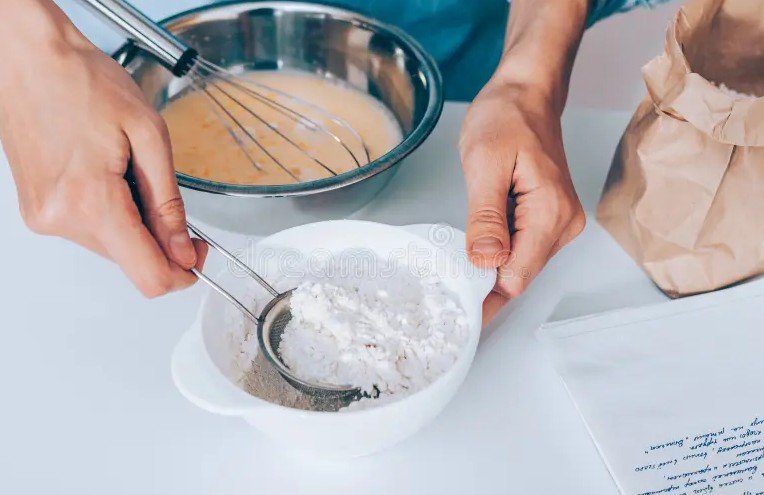
Whisk or sift the three together thoroughly before using — this distributes the baking powder evenly through the flour rather than leaving it in pockets, which is what causes uneven rising.
Quantities for Common Amounts
| Self-Raising Flour Needed | Plain Flour | Baking Powder | Fine Salt |
|---|---|---|---|
| ¼ cup | 30g | ⅜ tsp (1.5g) | Pinch |
| ½ cup | 60g | ¾ tsp (3g) | ⅛ tsp |
| 1 cup | 120g | 1½ tsp (6g) | ¼ tsp |
| 2 cups | 240g | 3 tsp (12g) | ½ tsp |
| 3 cups | 360g | 4½ tsp (18g) | ¾ tsp |
Gram weights based on spooned-and-levelled plain flour (120g/cup) and baking powder (4g/tsp) — the same figures already used on our Self-Raising Flour conversion page.
Why Teaspoons, Not Tablespoons, for Baking Powder
Baking powder is a precision ingredient, so it’s worth measuring it in teaspoons rather than tablespoons wherever possible. The teaspoon is 5ml everywhere in the world, but the tablespoon is not: the US, UK, and Canada use a 15ml tablespoon, while Australia uses a 20ml tablespoon — one-third larger. If a converted ratio is ever written in tablespoons, using an Australian tablespoon on it adds roughly 33% more leavening than intended, enough to cause an uneven rise or a bitter, soapy taste. Because the ratio above works entirely in teaspoons, this problem doesn’t arise here — but it’s worth knowing before trusting any tablespoon-based version you see elsewhere.
Common Mistakes to Avoid
Adding extra baking powder on top of a recipe that already lists self-raising flour
If a recipe calls for self-raising flour, the leavening is already built in. Adding more baking powder on top over-leavens the batter — the classic result is a cake that rises quickly, domes, and then sinks in the middle as the structure collapses.
Using bicarbonate of soda instead of baking powder
Baking powder and bicarbonate of soda are not interchangeable here. Bicarbonate of soda is a pure alkali and needs an acidic ingredient already in the recipe (buttermilk, yogurt, honey) to activate. Plain flour mixed with bicarbonate of soda alone will not rise properly, and may taste soapy or metallic.
Scooping the flour instead of spooning it
Scooping a measuring cup directly into the flour bag compresses the flour, and a “cup” measured this way can weigh 140–150g instead of 120g. More flour than the ratio accounts for means there’s now too little baking powder for the actual amount of flour used. Spoon the flour lightly into the cup and level it with a flat edge, or better, weigh it directly.
Can You Make a Bigger Batch and Store It?
Yes — scale the ratio above up as needed, mix thoroughly, and store it in an airtight container. Use it within two to three months. Baking powder gradually loses potency, especially in a warm or humid kitchen, so a batch stored much longer may not rise reliably even though the flour itself is still perfectly fine. To test whether a stored batch is still active, stir a small pinch into a cup of hot water — it should fizz noticeably. No reaction means it’s time to remake the batch.
Can You Turn Self-Raising Flour Back Into Plain Flour?
Not reliably — once the baking powder and salt are blended through, they can’t be removed. If a recipe genuinely needs plain flour, it’s best to start with plain flour rather than trying to work backwards from a self-raising bag.
Scaling a Whole Recipe
If you’re adjusting an entire recipe’s yield rather than just converting one ingredient, use our Recipe Scaler rather than scaling each ingredient by hand — it accounts for the fact that leavening agents like baking powder don’t scale in a straight line when a recipe is doubled or halved.
Frequently Asked Questions
Yes — “self-raising flour” is the UK and Australian term, “self-rising flour” is the US term. Both describe plain flour pre-blended with baking powder and a small amount of salt.
Commercially milled self-raising flour usually contains a small amount of salt, roughly ¼ teaspoon per cup. It’s optional when making your own — omit it if your recipe already adds salt separately.
No. Bicarbonate of soda is roughly three to four times stronger than baking powder and needs an acidic ingredient in the recipe to activate. Substituting it directly, without adjusting the rest of the recipe, typically produces a soapy taste and an unreliable rise.
Around two to three months in an airtight container, since the baking powder gradually loses potency. Test it by stirring a pinch into hot water — it should fizz. If it doesn’t, remake the batch.
Conclusion
Making self-raising flour from plain flour takes under a minute and needs nothing more exotic than baking powder and a little salt. The ratio to remember is 1 cup (120g) plain flour to 1½ teaspoons (6g) baking powder and ¼ teaspoon salt, whisked or sifted together thoroughly. Weigh the flour rather than scooping it, measure the baking powder in teaspoons rather than tablespoons, and the result will behave just like a commercially milled bag.