5 min read
In this guide
If you’ve ever followed a recipe from a different country and ended up with results that didn’t quite match the original, cup measurements are often the reason why. A cup is a unit of volume, not weight — and because different ingredients pack, settle, and compress differently, the same one-cup measure can weigh anywhere from under 100 grams to well over 200 grams depending entirely on what’s inside it.
This guide gives you exact gram weights for the most common baking ingredients, explains why cup measurements vary so much, and shows you how to convert accurately — whether you’re working from a US recipe, a UK recipe, or anything in between. If you want an instant answer for a specific ingredient right now, use our cups to grams converter tool.
Why Cup Measurements Vary (And Why It Matters for Baking)
Volume and weight are two fundamentally different things. A cup measures how much space an ingredient takes up — not how much it actually weighs. This distinction matters enormously in baking, where small measurement differences can change the entire texture of a finished result.
Consider plain flour. If you scoop a cup directly from the bag, the flour compresses under the pressure of the scoop and you can end up with 150–160 grams in a single cup. If instead you spoon the flour gently into the cup and level it off, you’ll get closer to 120 grams — a difference of roughly a third of a cup’s worth from the same measuring tool, used in two different ways. In a simple shortbread with only three ingredients, that difference is the gap between crumbly-perfect and dense-and-dry.
Granulated sugar, by contrast, pours freely and settles fairly consistently, so it’s more predictable by cup. Airy ingredients like icing sugar or cocoa powder weigh considerably less per cup than dense ingredients like packed brown sugar or butter. The short answer: for reliable baking results, grams are always more accurate than cups — but knowing the correct gram equivalent for each ingredient means you can work confidently with either system.
How Many Grams in a Cup? Quick Reference Table
The values below are based on a standard US cup (240ml), using the spoon-and-level method for dry ingredients.
| Ingredient | 1 Cup | ½ Cup | ¼ Cup |
|---|---|---|---|
| Plain / All-Purpose Flour | 120g | 60g | 30g |
| Rolled Oats | 90g | 45g | 22g |
| Granulated / Caster Sugar | 200g | 100g | 50g |
| Brown Sugar (packed) | 215g | 108g | 54g |
| Icing / Powdered Sugar | 120g | 60g | 30g |
| Cocoa Powder | 90g | 45g | 22g |
| Unsalted Butter | 225g | 113g | 56g |
Need a conversion not listed here? The cups to grams converter covers a growing list of ingredients with exact density values for each one.
Flour tip: if a recipe calls for self-raising flour but you only have plain flour on hand, you don’t need a separate conversion — you can easily make your own self-raising flour from plain flour and baking powder, and the cup weight stays almost identical.
Why Weighing Ingredients Gives You Better Results
Professional bakers and pastry chefs almost universally work by weight rather than volume, for a simple reason: a gram is always a gram, regardless of how tightly you packed the measuring cup, how humid the kitchen is, or which brand of flour you’re using. Volume measurements introduce a variable that weight measurements simply don’t have.
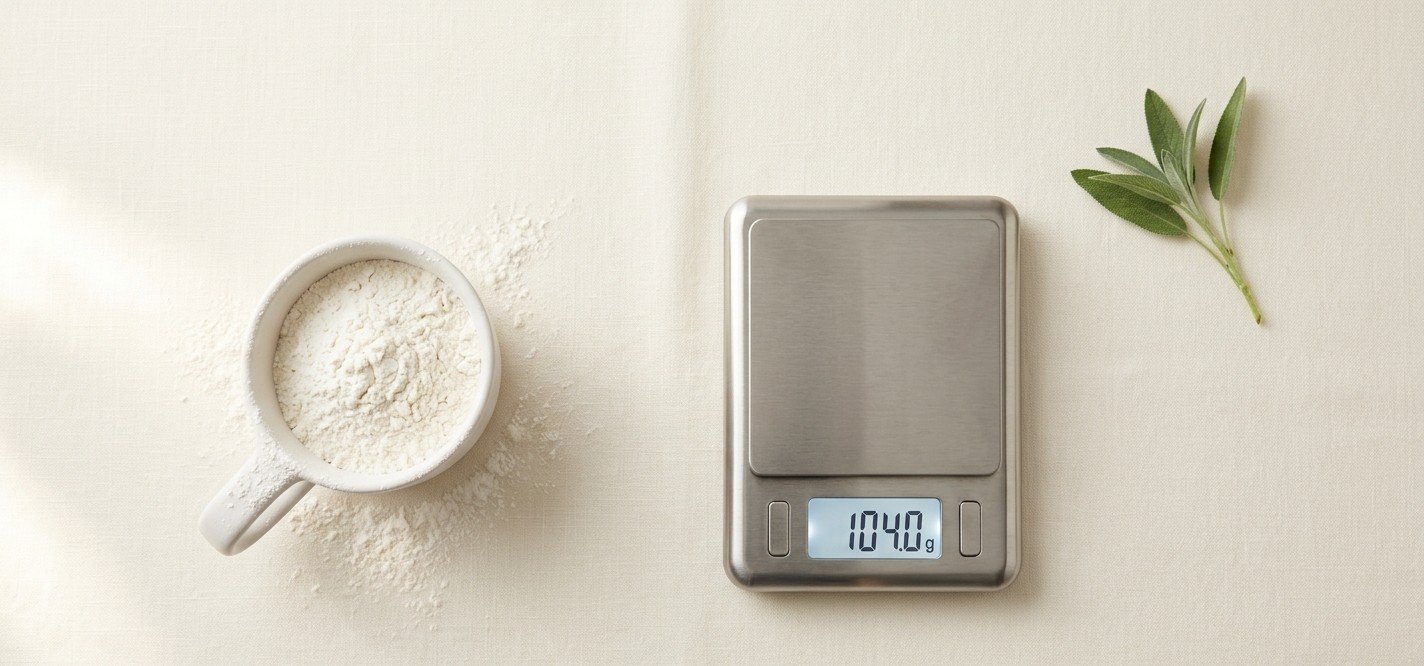
Switching to grams doesn’t require learning a new system — it only requires one tool. A reliable digital kitchen scale removes the single biggest source of inconsistency in home baking, and most models include a tare (zero) function that lets you add ingredients directly into your mixing bowl one at a time. If you don’t already own one, a reliable digital kitchen scale is genuinely one of the most useful single purchases a home baker can make.
US Cup vs Metric Cup — Does It Matter?
Not all cups are exactly the same size worldwide. A US cup is about 240ml, while the metric cup used in Australia, New Zealand and much of modern Canadian and UK baking is 250ml — a difference of roughly 4%. For most everyday baking, this is unlikely to be noticeable. Where it can matter is in recipes with tightly calibrated leavening ratios, such as bread or delicate pastries. Older UK recipes sometimes use imperial-style measures instead of a fixed “cup,” which is one reason many modern UK cookbooks list ingredients directly in grams and millilitres rather than cups at all.
Converting Fractional Cup Measurements — And Putting It Into Practice
Most recipes don’t call for whole cups — they use fractions like ¾ cup, ⅔ cup, or ⅛ cup. Once you know the full-cup gram weight, converting a fraction just means multiplying:
- ¾ cup plain flour: 120g × 0.75 = 90g
- ⅔ cup granulated sugar: 200g × 0.667 = 133g
- ⅓ cup rolled oats: 90g × 0.333 = 30g
If you’d rather not do the arithmetic yourself — especially when adjusting an entire recipe rather than a single ingredient — our recipe scaler handles fractional quantities automatically across every ingredient at once, and is worth bookmarking alongside this guide.