3 min read
In this guide
Scaling a baking recipe sounds simple — just double everything, or halve everything. For most ingredients, that’s exactly right. But a handful of ingredients don’t scale linearly, and getting those wrong is the most common reason a scaled recipe turns out noticeably different from the original.
The Simple Rule: Most Ingredients Scale Directly
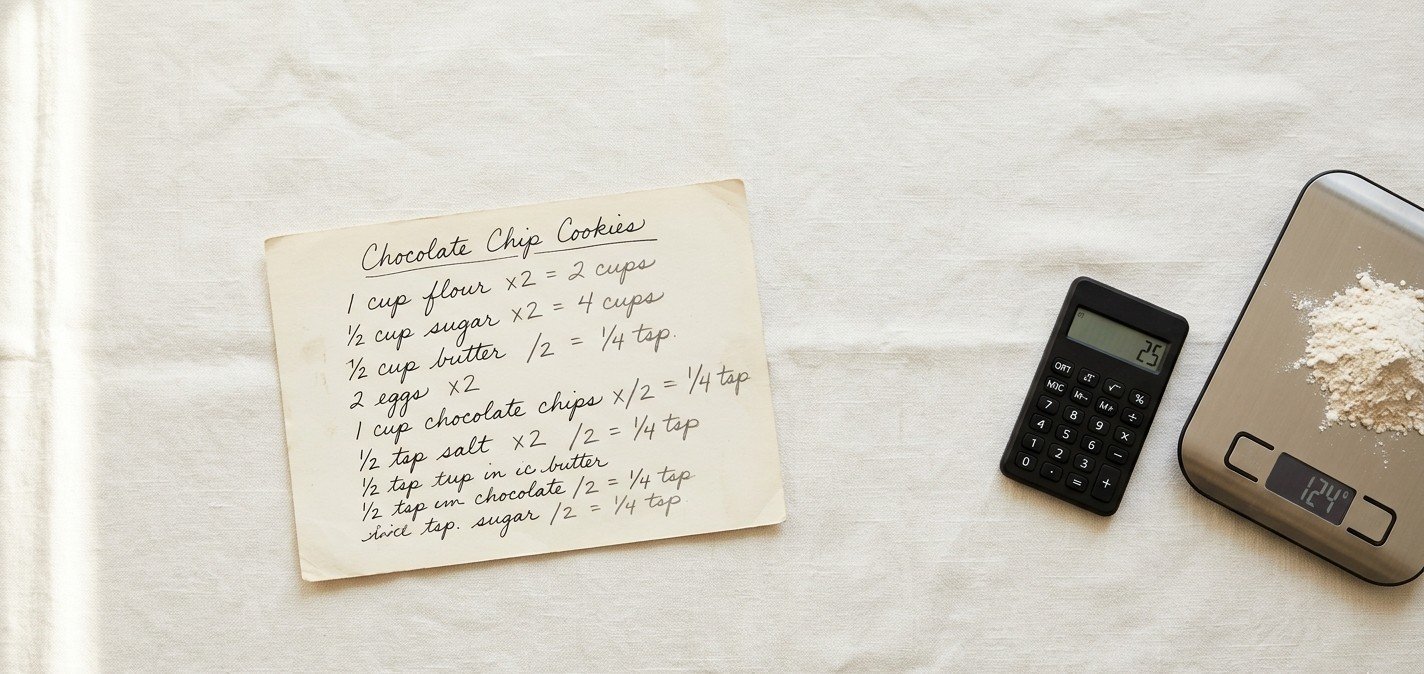
Flour, sugar, butter, eggs, milk, chocolate, fruit, and nuts scale by straightforward multiplication or division. If a recipe makes 12 cookies and you want 24, double every ingredient. The fastest way to do this without arithmetic errors is the recipe scaler, which handles any multiplier across every ingredient at once.
The Exceptions: Ingredients That Don’t Scale Perfectly
Leavening Agents
Baking powder and bicarbonate of soda don’t scale in direct proportion to the rest of the recipe. When doubling, use about 1.5–1.75 times the leavening rather than exactly double; when tripling, use about 2–2.5 times. Too much causes a cake to rise rapidly and then collapse; too little leaves it flat. When in doubt, err slightly low — you can’t remove leavening once it’s mixed in.
Salt
Salt’s perceived intensity increases slightly at larger quantities. When doubling, use 1.5–1.75 times the amount and taste-adjust if the recipe allows; when halving, use the full halved amount.
Spices and Extracts
Vanilla, cinnamon, and other strong flavourings follow the same principle — start with 1.5 times when doubling and adjust to taste.
Eggs
Whole-number scaling is straightforward. Fractional eggs (1.5, 2.5) are best handled by weight: crack the extra egg into a small bowl, beat lightly, weigh the total, and add half. A large egg without shell weighs approximately 50–53 grams, so half an egg is roughly 25–27 grams. See the egg size converter for reference.
Scaling for a Different Pan Size
When switching tin sizes rather than adjusting portions, the correct scale factor is based on the tin’s base area, not its diameter:
$$\text{Scale factor} = \frac{\pi r_{\text{new}}^2}{\pi r_{\text{original}}^2}$$
For example, scaling from a 20cm to a 23cm round tin: $$\frac{23^2}{20^2} = \frac{529}{400} \approx 1.32$$. Multiply every ingredient by approximately 1.32 to fill the larger tin to the same depth. The pan size converter calculates this automatically, including UK/US tin naming differences.
Adjusting Baking Time and Temperature When Scaling
More of the same-size items (more cookies, more muffins): baking time stays the same; you simply need more batches.
A bigger tin with a deeper batter: reduce the oven temperature by about 10–15°C, increase baking time, and check for doneness with a skewer earlier than expected.
A smaller tin with a shallower batter: keep the temperature the same, but check for doneness 10–15 minutes earlier.
Working in Grams Makes Scaling Easier
Scaling is far easier in grams than in cups and tablespoons — “1.32 cups of flour” requires estimation, while “158 grams” is exact and directly weighable. If working from a cup-based recipe, convert to grams first using the cups to grams converter, apply the scaling multiplier, and weigh each ingredient directly. A digital kitchen scale with a tare function is the one tool that makes this whole process straightforward.
Quick Reference: Scaling Rules Summary
- Flour, sugar, butter, milk, chocolate, fruit, nuts: scale directly.
- Baking powder and bicarbonate of soda: ~1.5× when doubling, ~2× when tripling.
- Salt, spices, vanilla: ~1.5× when doubling; taste and adjust.
- Eggs: scale directly to whole numbers; use weight for fractional eggs.
- Different tin size: use the area-ratio formula or the pan size converter.
- Baking time: unchanged for same-size items; adjust for different tin depth.